
Cash Is a Position: Liquidity for Military Financial Independence

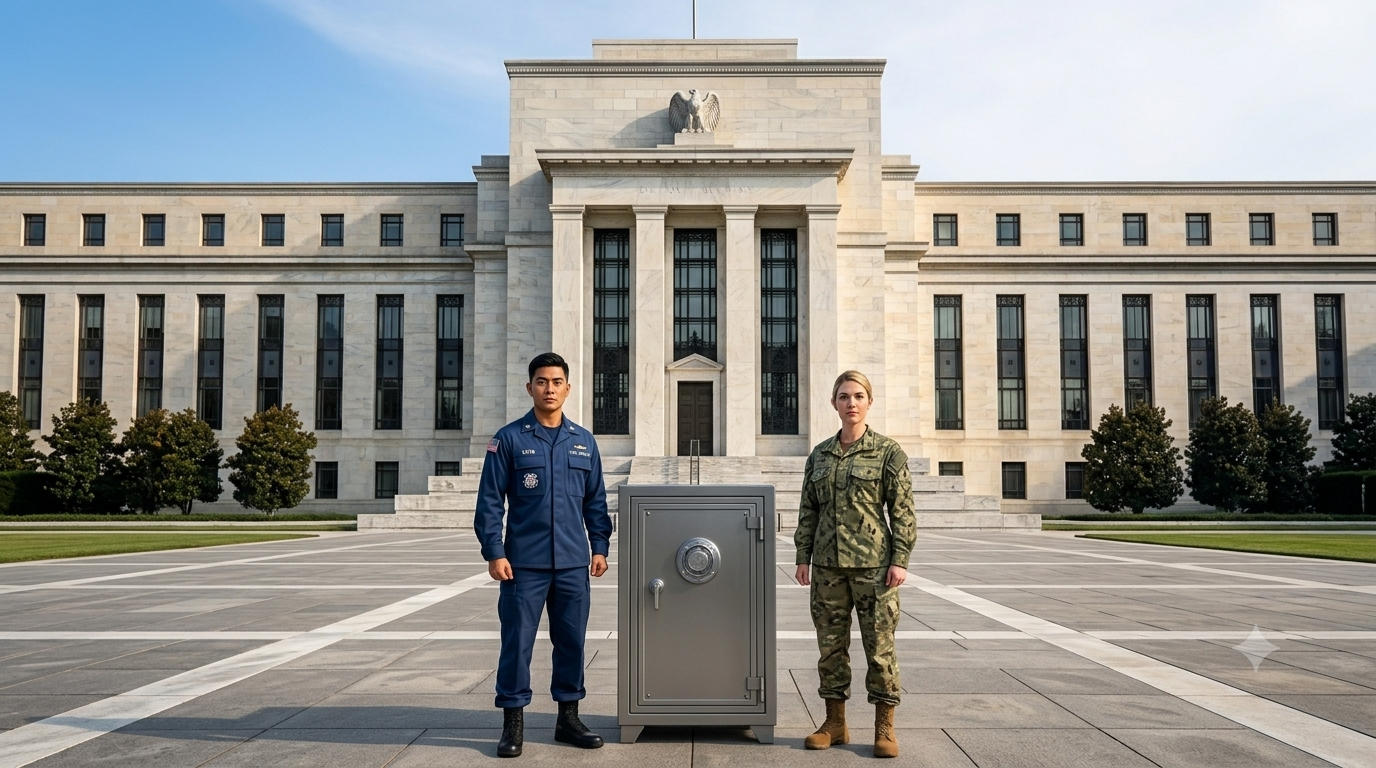
I got a real education in this the week a market correction hit right as the rear suspension on my wife's CRV completely failed, the credit card bill for our Christmas travel and gifts arrived, and the refrigerator compressor stopped working. Nothing about that week was a crisis by itself, but taken together, with zero liquidity and every dollar sitting in the TSP C Fund and VTSAX over at Vanguard, it felt like one. That's the week I stopped treating "I'm invested" as the same thing as "I'm prepared."
Three posts in, here's where we stand. You've charted your Whole-Life Portfolio. You've put the TSP back in its proper role as your Reserve. You've untangled the three-accounts-one-bet problem hiding inside retirement accounts that only looked diversified, and you've seen where Preservation of Capital actually gets bought.
Two Core Missions are still sitting unassigned. Liquidity and Income. They're the two this series has been circling from the beginning, and they're the two that determine whether your wealth does anything for you before your sixtieth birthday.
Cash Is a Position, Not a Failure to Invest
Somewhere along the way, the personal finance world taught you that cash is what you have when you haven't gotten around to investing yet. Money sitting still. Money losing to inflation. Money you should be embarrassed about.
That framing has cost military families more than almost any other piece of conventional advice I encounter.
Cash is the only asset in your entire portfolio that can be deployed same-day, at full value, with zero market risk and zero permission required. Not "in three business days." Not "after I sell something at whatever price the market offers me Tuesday." Today, at par, no questions asked. In military terms it's your Main Effort: the Queen on the chess board, the piece with the most freedom of movement, and freedom of movement is what lets every other piece do its job.
Here's what that buys you concretely. When the transmission goes at the same moment the market is down 22%, the household with cash writes a check. The household without cash uses a credit card and handcuffs themselves with bills for months to come. The household without cash but with stocks sells equities at the bottom to pay a mechanic, converting a paper loss into a permanent one, and doing it at the single worst moment available. Same net worth on paper a month earlier. Completely different outcomes.
That's the real function of the War Chest, your cash fund for offensive maneuver, and why we teach it as a separate position from your Emergency Savings Fund. The ESF absorbs the car repair and refrigerator repair; the War Chest is offensive cash: the money that lets you buy when everyone else is forced to sell, take the rental property when it appears, or say no to a bad job offer because you can afford to wait.
Wealthy households don't hold cash because they're timid. They hold cash because it's their Main Effort — the Queen, the most powerful and maneuverable asset in the game. Cash gives optionality, and optionality is the thing that compounds.
The Assets That Pay You Now
Now the second unassigned mission, and the one almost nobody talks to junior Service Members about.
Nearly every dollar you've saved is locked until age 59½. The TSP. The IRA. That's fine: that's the Reserve doing exactly what a Reserve does, growing for as long as possible before being committed at the final stage of the battle to secure victory. But it produces a strange outcome: you can spend 20-40 years building that wealth and actually get to experience ZERO improvement in your life the entire time. Every dollar working, but only for a distant future.
Income is the mission that fixes that. And the useful distinction is between the assets that only pay at the end, and the assets that pay you along the way.
Real estate is the clearest example of the second kind. Buy a duplex with a VA loan and a tenant, and it starts producing Income the month you close, not in thirty years. Better still, it's the rare asset that's genuinely countercyclical to your stock portfolio. If you recall, bonds, which Wall Street tells you protect you in a market freefall, are correlated 0.3 with stocks. This means that 60% of the time they go the same direction: 60% of the time losing value at the same time your stocks lose value is not downside protection.
In stark contrast, real estate moves with the stock market at a correlation of roughly 0.14 in its most closely related segment, residential, and completely counter in commercial real estate at a correlation of -0.6. That is actual downside protection. On top of that, real estate values march in lockstep with inflation at 0.94, meaning rents and property values climb almost dollar-for-dollar with your cost of living. Non-correlated to your equities, tightly correlated to your expenses. That combination is rare, and it's why real estate is your Air Power in this framework: it delivers Income and inflation resistance simultaneously, starting immediately.
And it does one more thing no index fund will do: it lets the bank fund most of the position while a tenant pays down the loan. That's leverage working in your favor, and it's why, for a lot of military families, real estate builds wealth faster than the C Fund ever will. Consider this: your TSP is 96% self-funded (4% by DoD), and in a margin account for your brokerage you are typically capped at 50% leverage. But in real estate you can use 80%, 90%, or even 100% leverage to buy. Put in dollar terms, $20,000 can only buy $20,000 worth of stocks, but it can buy $100,000, $200,000, or even more real estate. Wealth grows faster.
When real estate isn't available yet, the Income mission doesn't get skipped. Deployment schedules, a high cost-of-living duty station, a credit picture that needs another year — these are real constraints. Publicly traded REITs and dividend-paying funds sit in any brokerage account, at any dollar amount, and produce an income stream while you get into position for the real thing. You give up the leverage a mortgage provides. You keep the cash flow. That's a fair trade while you wait, and a poor substitute if you wait forever.
That's everything new in this post. Every other mission on the board already has an owner — let's walk the whole thing.
The Missions and Your Wealth Task Force
If you've read this series in order, nothing below is new. This is what the board looks like now that every mission finally has one.
Growth is the C Fund — over 500 of the largest companies in the world's largest economy, at 0.035% cost, doing the one job it's actually good at.
Preservation of Capital is where Part 3 already ruled out the F and G Funds on the numbers: the G Fund returned 2.89% annually over the past decade, the F Fund 1.63%, against inflation averaging 3.33%. Both lost purchasing power at the exact job they were hired to do. That same arithmetic scales to the entire bond market, and it's worth understanding why, because the 60:40 portfolio is going to be sold to you for the rest of your life. Bonds earned their "safe half" reputation during a multi-decade stretch of falling or stable rates and manageable federal deficits. Neither condition reliably holds anymore: the U.S. runs structural fiscal deficits, and in May 2025 Moody's stripped the federal government of its last AAA-equivalent rating, cutting it to Aa1 and citing exactly that trajectory. Bond prices move opposite interest rates, so a broad bond fund gives you no ability to manage that exposure; it just rides its average maturity down with everyone else holding the same index. 2022 wasn't a fluke — the U.S. Aggregate Bond Index fell 13% the same year the S&P 500 fell 18%. The ballast sank with the ship.
A High Yield Savings Account or Money Market Account, by contrast, is FDIC- or NCUA-insured up to $250,000 per depositor, per institution, pays roughly 3.50% to 4.50% today, and, paired with the gold ETF Part 3 already put in your Roth IRA, gives you a firmer floor for Preservation of Capital than a bond fund currently offers.
There's only one honest exception: if you're actively managing duration, which means positioning deliberately for falling-rate price appreciation while watching call schedules, bonds have a real role. That's active management, not index investing. And if rates ever spike toward 12% or 15% the way they did in the early 1980s: buy bonds and lock that yield in. That's not a contradiction of this argument. It's the argument, applied correctly.
Liquidity is cash, full stop. Your Main Effort, and the only mission nothing else on this list can substitute for.
Income. As covered as a theme throughout the series, these are investments that align with your comfort level, risk profile, and values — and are outside your retirement fund. We give our strongest recommendation to real estate, but there are multiple alternatives: REITs, a non-retirement after-tax brokerage, and more. While the other missions tend to match specific vehicles or strategies, the Income mission has the most flexibility for you to choose.
Run all four missions through the same screen this series opened with: does this still do its job once inflation gets a vote? Growth that doesn't beat inflation isn't growth. Cash sitting flat instead of in a 4% HYSA isn't Liquidity done right. That's the whole board, four missions, each with an owner, each stress-tested against the one condition that never goes away.
What This Actually Is
Here's what I haven't said outright in three posts, and should.
This series isn't a rebuttal of your TSP, and it isn't a hot take on bonds. It's an attempt to hand you the fundamentals Family Offices of UHNW (Ultra-High Net Worth, or households with over $30 million in net assets) and wealthy family trusts actually operate on, translated down to a scale a Service Member can execute. Those portfolios run on a few consistent principles: a large core of high-conviction, directly-owned assets doing the real work of Growth and Income, including equities, real estate, business equity, and more. A smaller, deliberately bounded sleeve of higher-risk, higher-reward opportunistic capital, sized to survive being wrong about it. And cash held on purpose, not as leftovers.
Most of the specific vehicles UHNW families use for that middle sleeve — venture capital, private equity, direct placements — are legally restricted to accredited investors, and I'm not going to pretend otherwise or suggest you chase them before you're eligible. And there are crowd-sourced variations of these that you can access today. What scales down regardless of accreditation is the discipline behind it: real assets doing real work, a cash position sized on purpose, and a bounded appetite for risk instead of an unbounded one. That's what this series has actually been teaching, one mission at a time.
If you're serious about preserving liquidity, securing your retirement, fending off inflation, and increasing your pre-retirement income through smart asset allocation, that's a conversation worth having directly. Give me a call to discuss your specific position, needs, and goals →This content is educational in nature and does not constitute financial advice. You are responsible for your own financial decisions. When in doubt, consult a licensed financial professional.
Run your own numbers. Size your own cash reserve against your own expenses. The War Chest Optimizer is free and needs no signup. Open the War Chest Optimizer.
One tactical money move, every Tuesday.
Join thousands of service members getting plain-English personal finance built for military pay, BAH, and the TSP.